

If growing your business means working more hours, at some point you’re going to hit a ceiling.
Because there are only so many hours you can work – and the answer isn’t to get faster or do more.
It’s to change your role in the business.
This is something you’ll do again and again as your business grows.
The first time, it might mean a significant shift in how your business runs.
If you’ve already done a lot of that work, it becomes refinement: what’s the next thing you’re still too involved in? What’s the next layer the business needs to stop relying on you for?
Let’s look at 3 things that make a big difference when you want to grow, but you don’t want that growth to mean more hours, more work and more stuff landing on your plate.
Because the goal here isn’t just to save you a few hours. It’s to create the space for you to actually lead and grow your business.

Hi! I’m Moira. 👋🏻 I work with small business owners who’ve outgrown the way their business runs. When your business is working but you’re holding too much of it yourself, I help you shift how you see your role and make the decisions that will create capacity – so you can step out of the day-to-day and actually grow.
Okay. Let’s start with the big one.
1. Creating White Space
If your working week is already full, your first job is not to work out how to squeeze more into it.
It’s to take things out.
Imagine your business is a desk. And right now that desk is completely covered: Laptop. Papers. Post-its. Coffee mug. Pens. Headphones. Handcream. Notebooks. Stuff everywhere, right to the edges.
And then someone hands you the blueprint for the next stage of your business.
Where are you going to put it? There’s no room.
Prefer to watch? Here’s the video:
That’s what I see happening in established businesses all the time…
You want to write the book. Start the podcast. Launch the new offer. Create the retreat. Scale what your business can handle.
But every inch of your week is already occupied by running the business you have now.
So clear the desk.
Look at what can be simplified.
- What can be automated?
- What could somebody else do?
- What are you doing simply because you’ve always done it?
- What isn’t actually working anymore, and you can just stop doing?
I have a whole framework called SALSA that I use for this, and I’ve done another video on that – you can watch that here:
Remember, we’re looking for your next layer.
Maybe there are ten hours of admin that should never have been yours in the first place.
Or maybe you already have a team and good systems – but for example, when you look closely, you’re still the person making decisions that someone else could make.
That’s a layer of refinement.
Where is the business still using you when it doesn’t need you?
Fix that. Then come back and ask the question again.
One of my clients is a great example of this.
When we started working together, she was looking to release a virtual assistant role and see if systems could carry the weight instead. She could.
But the interesting result wasn’t the time or money she saved. It was what that capacity made possible – she opened a second venue. That’s the deeper payoff.
Saving five hours a week is fine. But what can those five hours become?
- They could become the book you’ve been saying you’ll write for years.
- They could become a new revenue stream.
- They could become Fridays off.
And maybe Fridays off means you arrive at the weekend as a person who’s excited to do something with your family, rather than trying to drudge up energy from somewhere because you’ve got nothing left.
That’s what we’re actually creating capacity for.
Not an emptier calendar for the sake of it. We’re creating room for something else.
2. What Are You Avoiding?
Now you’ve made some room, I want you to ask yourself a slightly uncomfortable question.
What are you avoiding? (And I’m not talking about your tax return. 😂)
I mean the thing you have an inkling about.
That nudge in your stomach, the idea that keeps coming back into your head.
If you’ve been running your business for a while, you know a lot.
- You know your customers.
- You know your business.
- And quite often, you already have a pretty good instinct about what needs to happen next.
But busyness is extremely convenient camouflage.
Because you can keep saying: “I just don’t have time to think about that right now.” – and that can remain true for YEARS if you keep filling every available space.
This is where growing your business without working more hours becomes an identity shift.
Because in the early stages of your business, more effort probably did create more growth.
You were resourceful.
You figured things out.
You did the work.
You said yes.
You made it happen.
And that worked.
But eventually, the thing that got you here can become the VERY thing that’s keeping you here.
You don’t need to get better at carrying more. You need to get better at deciding what deserves you.
My uncle is a proper petrolhead. He’s had some very petrolhead cars over the years, and I think he was slightly horrified when I told him I learned to drive in an automatic.
So he will probably tell me everything that is technically wrong with this analogy…
But if you want a car to perform at a completely different level, at some point you can’t just keep pressing harder on the accelerator.
You have to change the machine.
I think we do the equivalent in business all the time.
- More content.
- More clients.
- Another launch.
- Work a little bit later.
- Have a quicker lunch.
- Just push a bit harder.
- More accelerator.
At some point, you have to upgrade the car.
In your business, that might be the systems.
It might be your team.
It might be the decisions you’re making.
And sometimes it’s you. It’s how you see your role and what you believe you should still be responsible for.
Because if you want the business to operate differently, you have to be willing to operate differently inside it.
3. Leave Some Of The Desk Empty
This is the bit I think we often miss.
Once you’ve created that white space… don’t immediately fill it again.
Leave some of the desk empty.
Because some of the biggest opportunities in your business aren’t going to arrive neatly labelled:
BUSINESS GROWTH OPPORTUNITY.
PLEASE ALLOCATE THREE HOURS ON THURSDAY.
They’re going to appear in conversations.
- Someone mentions something and you think, hang on…
- A client asks you a question that makes you see a gap.
- Someone invites you to something.
- You meet the right person.
- You see what’s happening in your industry and spot something other people haven’t spotted yet.
- You get an idea while you’re walking the dog.
Have your spidey senses open.
Raise your hand. Have the conversation. Follow the thread.
Because when you are absolutely slammed, you can have a brilliant opportunity sitting right in front of you and think: “That sounds really interesting. Maybe later.”
And then go back to your inbox.
You need enough space in your business – and enough space in your brain – to notice what is happening around you and actually do something with it.
This is where we have to stop seeing white space as wasted space.
White space is part of the growth strategy.
- It’s where you think.
- It’s where you notice.
- It’s where you make the decision you’ve been circling for six months.
- It’s where you have the conversation that changes something.
- It’s where you stop automatically responding to what the business needs from you today and start deciding what you want it to look like next year.
Because ultimately, the aim isn’t to build a bigger business that needs a bigger and bigger chunk of you to keep it running.
It’s to build a business that gives you the capacity to do the work you’re best at, make the decisions that only you can make, spot and act on opportunities – and have a life outside of it.
That is a very different way to grow.
Find the capacity hiding in your business
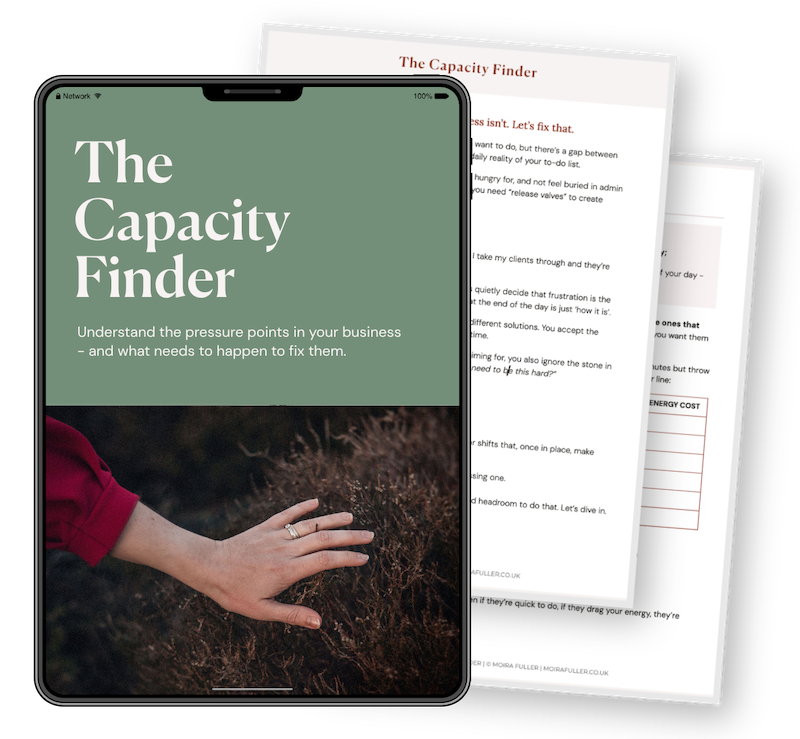
If you’re thinking, “Okay, but what do I actually need to take off my desk?”, start with my free Capacity Finder.
It’ll help you identify the 1–3 key release valves in your business that could create more capacity, and start working out what to do about them.
If you’d rather work through those decisions with experienced eyes on your business, you can learn more about a Next Level Audit right here.
Thanks for reading!
