

You didn’t start a small business to become a full-time admin department.
In this article, I’ll share the five ‘mistakes’ I often see with the small businesses I work with (especially if you have a creative mind – keep an eye on number 5!) – across products, services, courses, brick-and-mortar. If you feel trapped in admin, one of these five is almost always why.
As you read, tally up which of the 5 are true for you – because once you can see what it is, it’s easier to solve for.

Hi! I’m Moira. 👋🏻 I work with small business owners who’ve outgrown the way their business runs. When your business is working but you’re holding too much of it yourself, I help you shift how you see your role and make the decisions that will create capacity – so you can step out of the day-to-day and actually grow.
1. Role Misalignment
Mistake number one is role misalignment – being stuck in admin.
Part of this might be practical: Do you have the structure and systems in place that allow you to get out of admin? (This can often be easier than you think.)
But there’s also a self-identity piece here.
Because if your assumption is, “I’ll just do it. It takes me a few minutes. It’s got to be me”, then you’ll never even look for solutions. And those solutions don’t need to mean hiring or a fancy system.
Sometimes it’s simplification.
Sometimes it’s boundaries.
Sometimes it’s removing steps that never needed to exist in the first place.
When you’re stuck in an admin role, your questions might sound like this:
– Can I squeeze this in quickly?
– Will it be faster if I do it myself?
– Why is this landing back with me again?
– How do I just get through today’s list?
When you’re leading the business, the questions shift:
– Should this step exist at all?
– What’s the simplest way for this to happen each time?
– Where would a boundary solve this better than ‘doing’?
– What needs my judgment here? What doesn’t?
In the early stages of business, it’s normal to be involved in every detail – you’re working out what works. But if you stay there too long, you keep solving at the wrong level.
Here’s the reframe: If you think of yourself as the leader of your business – leading decisions, leading priorities, leading what matters – then you solve for problems at that level.
But if you see yourself as the person who has to be up to their elbows in the weeds, you’ll keep solving for admin problems. And you can’t grow a business from inside the admin role.
Prefer to watch? Here’s the video:
2. Lack Of Trust In Structure And Support
Mistake number two is a lack of trust in structure and support.
- You might already have some systems in place, but you don’t trust them, so you dance around them or have turned them off.
- Or you have team support, and you still feel like no one else can do it as well as you can.
Let’s look at structure first. If you don’t trust a process, the test is simple.
Go through it like you’re the client. For example, if it’s onboarding, run onboarding. Set a coupon for 100% off so you can experience what a client would experience.
When you do that, two things usually happen.
- One, you’re more confident in the process, because you can actually see what works.
- Or two: you spot exactly where the process is clunky or overcomplicated – so you know what to fix.
Because “it only takes a few minutes” really adds up. Not just in time – but in energy, in context switching. It drains you – and your team – way more than people think.
Now, if the trust issue is about your team, that’s a different challenge.
Ask yourself:
- Do they have SOPs – standard operating procedures – so they know exactly what to do?
- Are the decision parameters clear?
- Do they know what they have autonomy on, and what they need to come back to you for?
If those answers are fuzzy, you’ll keep jumping in – because you’ll be so used to your team asking you questions. You won’t have built up trust that they can actually do it themselves, given the right resources.
I go into this in more depth in this video – you can watch it here:
3. Not Knowing Your ROI (Attract, Nurture, Sell, Deliver)
Mistake number three is not knowing exactly what’s working in how you attract, nurture, sell, and deliver.
| Stage | What I need to know |
|---|---|
| Attract | How people first come across you |
| Nurture | What helps them stay engaged and move closer to buying |
| Sell | What turns interest into a purchase |
| Deliver | What happens after the sale, and how you deliver the offer / transformation |
This is where I see a lot of small business owners get stuck. You’re really busy. You’re doing all the things. But you don’t necessarily know which activities are producing results – and which ones are just “busy work”.
If you’re not tracking what’s working in –
- How people first come across you
- How you nurture them toward becoming a customer or client
- How you sell
- And how you deliver your offers
Then you can easily spend time and money on things that don’t need to be happening at all. That’ll have a big impact on your profitability and growth.
You don’t need perfect dashboards and fifty data points. You do need enough attention to tell the difference between something that’s helping and something that’s ‘busy work’.
How do you find this out (especially for attract, nurture & sell)?
It can be very simple. Ask them. When someone purchases, ask where they heard of you.
You can get a lot more detailed – e.g., UTM tracking how someone signs up to your newsletter list (if your email service provider supports it); looking at heatmaps for how people use your website; and so many more.
But if you’re not doing anything at all, adding a question to your checkout form or directly asking clients is a quick start.
4. Try To Fix With Tools, Instead Of Decisions
Mistake number four is trying to fix with tools instead of decisions.
This is where people can start layering up tech.
More tools. More automations. More integrations.
And sometimes tools are helpful. But I’ve seen extremely convoluted systems where someone is using four or five different tools for a process that could literally be two steps.
This can happen because tools connect things up – and sometimes it feels easier to connect more tools than it is to make a decision.
A decision like:
- What is the simplest path to the outcome?
- What is the fewest number of steps?
- What are we no longer doing?
If you feel like your business has become a maze of tools, there’s a good chance the real fix isn’t another platform. It’s making a simplification decision.
5. Your Creative Role Has Changed
Mistake number five – especially for creative businesses – is that your creative role has changed.
You’ve gone from being the creative – to being a creative leader. And by leader, I don’t necessarily mean you’re leading a big team. I mean you’re leading the business.
If you started a creative business because you love the creative parts of what you do, over time that can evolve.
Your creativity can still come out in the craft. But it can also come out in how you run the business. And the key decision is: what do you actually want now?
- How much do you personally want to stay involved in the creative output that is the core offering?
- And how much do you want to focus on the creativity of building the business – growth, offers, delivery, decision making?
Where people can feel torn is when they’re pulled in both directions – without intentionality.
When you’re intentional, you can ringfence and protect your time for exactly what you want to be involved in.
I’ll link my SALSA video if you want a deeper breakdown of protecting your time – you can watch it here:
This might also look like hiring support for some of the creative elements of your business, so you can lean further into the creativity of running the business.
This was the decision I made with my craft subscription box business – after a few years, I hired a craft kit designer to develop the projects, while I stayed focus on the business. That might not be the right decision for you – explore what you want now.
Where I’d Start With This
Which of these resonated the most?
1 – Role Misalignment
2 – Trust
3 – Not knowing what’s working
4 – Tools over decisions
5 – Creative leader shift
Most small businesses won’t have only one issue. That’s normal.
I often see two or three showing up together. Role misalignment makes it harder to trust support. Fuzzy clarity on what’s working can lead to layering up tools. A changing creative role makes old systems stop fitting. This stuff overlaps.
I wouldn’t try to fix all of it at once. I’d look for the one or two places that would release the most pressure fastest. That’s where you’ll usually get capacity back.
Find the capacity hiding in your business
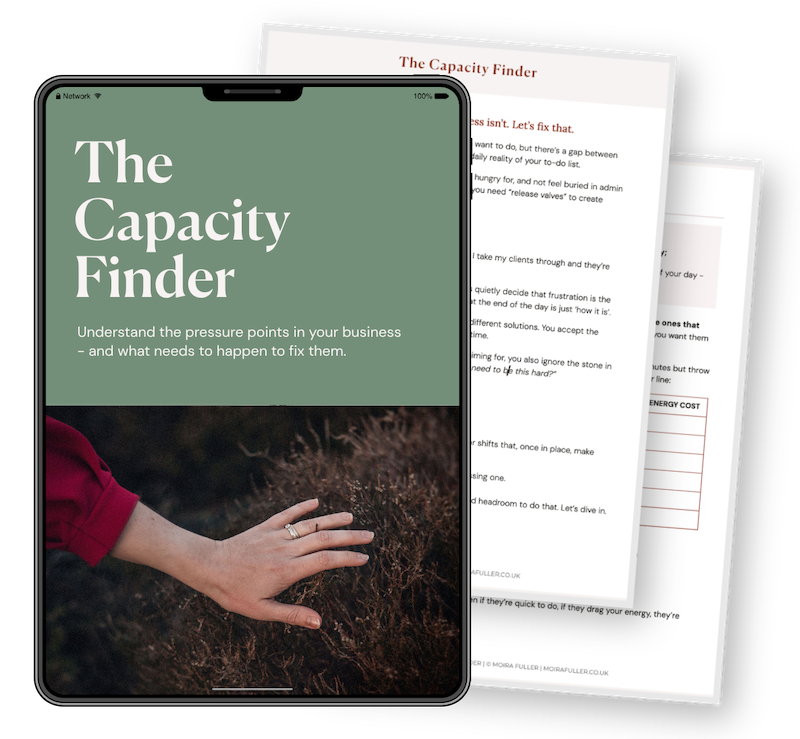
If you’re thinking, “Okay, but where do I even start?”, get my free Capacity Finder.
It’ll help you identify the 1–3 key release valves in your business that could create more capacity, and start working out what to do about them.
If you’d rather work through those decisions with experienced eyes on your business, you can learn more about a Next Level Audit right here.
Thanks for reading!
