Introduction: Why Simple Business Systems Beat Complicated Ones
If your systems feel duct-taped together, or you’re spending more time maintaining them than actually running your business, you’re not alone.
I’ve worked with too many business owners who’ve lost money and energy because their systems were overcomplicated — and I don’t want the same to happen to you.
The truth is, you don’t need elaborate setups or fancy tech to run a streamlined, professional business. The simplest solutions are usually the ones that save you the most time, money, and headspace.
Here are the first three areas I look at with clients — and the ones that can transform how smoothly your business runs.
STEP 1: Don’t Overcomplicate Your Systems
When it comes to systems, it’s tempting to think that “more sophisticated” equals “more professional.” But that couldn’t be further from the truth.
I’ve seen business setups so convoluted that a contortionist would be impressed. And I’ve seen people spend a small fortune on systems that might be brilliant for someone else, but are total overkill for their business.
So ask yourself: What am I trying to achieve? And what’s the simplest path to get there?
One of my favourite examples comes from the Indiana Jones films. In Raiders of the Lost Ark, Indy is faced with an elaborate sword fight — but instead of engaging, he simply pulls out his gun and shoots. A much simpler, faster solution.
In your business, where are you creating the big sword fight when a straightforward “shortcut” would get you to the outcome faster?
Step 2: You Don’t (Usually) Need Fancy Tech Systems
Another common misconception is that good systems require fancy tools. While sometimes the right software makes a big difference, often a checklist, template, or simple workflow is exactly what you need.
When I work with clients, I always look at what tech they already feel comfortable with. What’s working for you right now — and can we build on that?
Here’s an example: one client had over 200 beautifully formatted product documents saved in a program on her desktop that only she could use. She’d become the bottleneck for updates, and it wasn’t possible to delegate.
Instead of recreating everything in another design tool, we simplified. We:
- Shifted her documents into clean, beautifully branded Google Docs templates
- Used Airtable to track the links for the documents (internally to edit, and where they were shared externally) plus any internal notes
Now her team can find and update everything easily – without needing design skills — and nothing is stuck on her computer.
Sometimes tools like Zapier or Airtable are the best option because of what they specifically do (e.g., handling volumes of data elegantly, or connecting automations).
But if you have more than one option for how you create a system, the best system is simply the one you’ll actually use.
Step 3: Establish a Source of Truth for your Business
Your business needs a central ‘source of truth’ for your systems.
In this ‘source of truth’, links to all your checklists, SOPs, important links, and resources will live. Then you won’t waste time searching for things you half-remember creating, or reinvent the wheel each time.
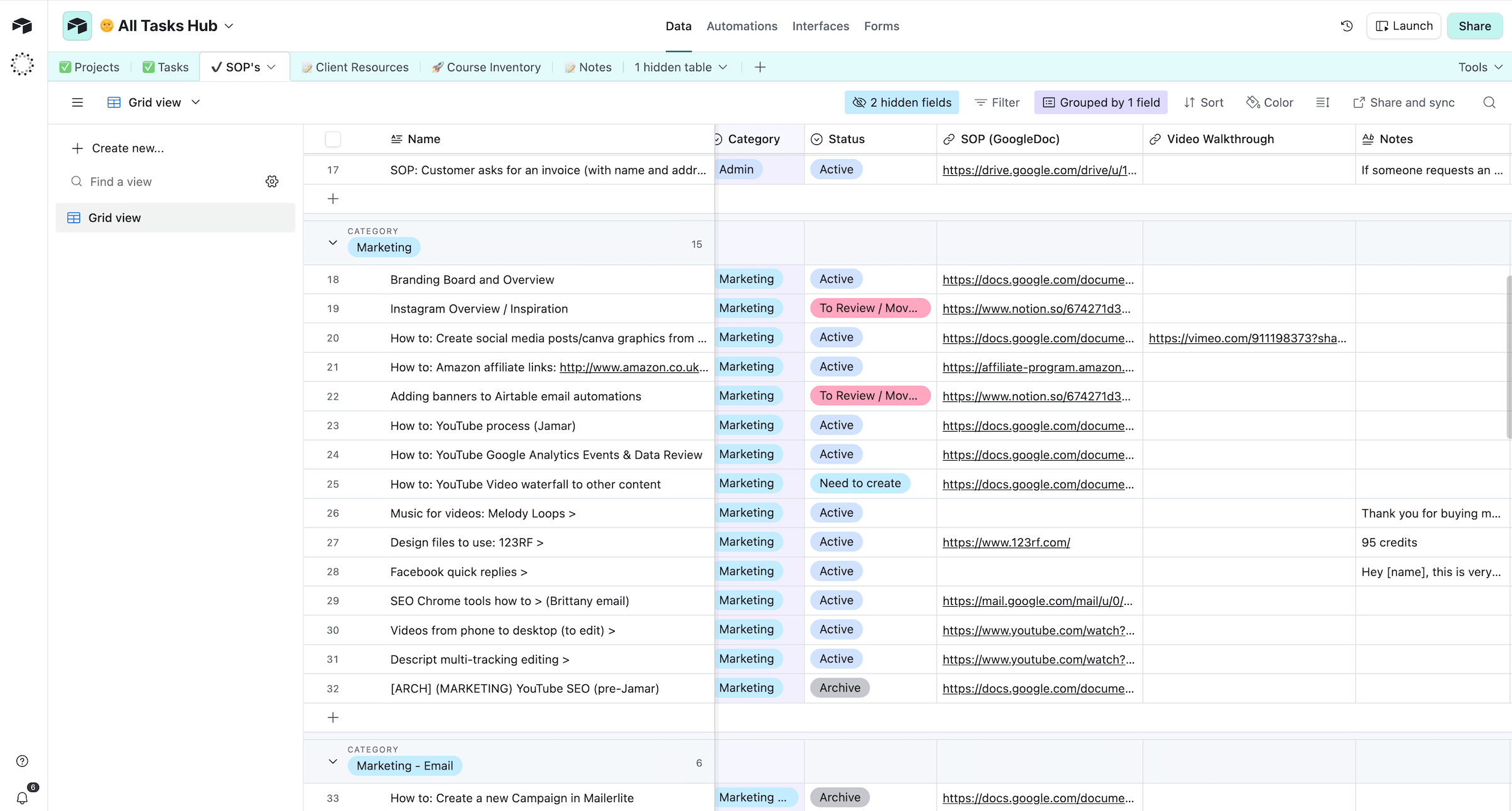
Here’s what my hub looks like in Airtable, though you can just as easily set yours up in Notion, Asana, or Google Drive, whatever works for you:
I include:
- Name: using the terms I’m likely to search for later
- Category: to make it easier to group and find things
- Status: e.g., active or needs review
- Link to SOPs: I now create my SOPs in GoogleDocs, but I’ve also linked to online how-to’s from software companies, or our older SOPs which we held in Notion. The beauty of this is that you can link to anywhere, and have them all gathered in one place.
- Video walkthroughs: E.g., if you’ve recorded any how-to’s for your team
- Internal notes: any other context or reminders
Bookmark your hub so it’s always one click away. It becomes the place you and your team can rely on, making everything easier to manage.
Key Takeaway: Keep It Simple
Your systems don’t have to be complicated to be effective. In fact, simple systems are usually the smartest.
By focusing on the outcome you want, choosing tools you’ll actually use, and creating one clear source of truth, you’ll stop wasting energy on admin — and free up space to think, lead, and grow.
Ready to Take Action?
Want to put this into practice? Download my free Simplify Operations guide and use the same audit process I take clients through to identify their biggest time and energy drains, and create simple, impactful systems to handle them – you can get it here.